



Dear Friends,
In the course of our ongoing work to improve the financial health and wealth of people in under resourced communities across the Deep South, opportunities abound to facilitate connections between those whose interests align with these objectives. Several examples are on display in this quarter’s report.
In April, roughly 150 local, regional and national leaders joined us in Cleveland, Mississippi for the first of three planned HOPE Economic Mobility Forums and Community Leadership Institutes, focused on “Seizing the Moment: Maximizing Federal Investment in Under Resourced Communities.” During the Cleveland event, participants engaged in discussions and work sessions toward a goal of ensuring that people and places like those in the Delta benefit from the historic levels of federal resources that are available to support infrastructure, jobs, climate resiliency and advance a stronger and more inclusive economy.
Making connections that increase economic mobility is at the core of HOPE’s work. In this report, you will see this in stories about a member’s transition from supportive housing to homeownership, an entrepreneur’s persistence after being denied a loan by other financial institutions, and small businesses and larger companies coming together to address their mutual needs.
The alignment of collective interests is on full display in “Reaching for the Stars,” which details how a $13 million New Markets Tax Credit investment by HOPE helped catalyze public, private and philanthropic support to renovate the Russel C. Davis Planetarium in Jackson, Mississippi. Long in need of reinvestment, restoration of the planetarium will help invigorate commerce in the downtown area, and serve as a hub for science education and enrichment.
As a programmatic partner, donor, Transformational Depositor, or another of our many valued allies, your support is vital to all that we do at HOPE. We look forward to expanding our work together to advance opportunity throughout the Deep South.
Sincerely,

Bill Bynum
Thriving with HOPE
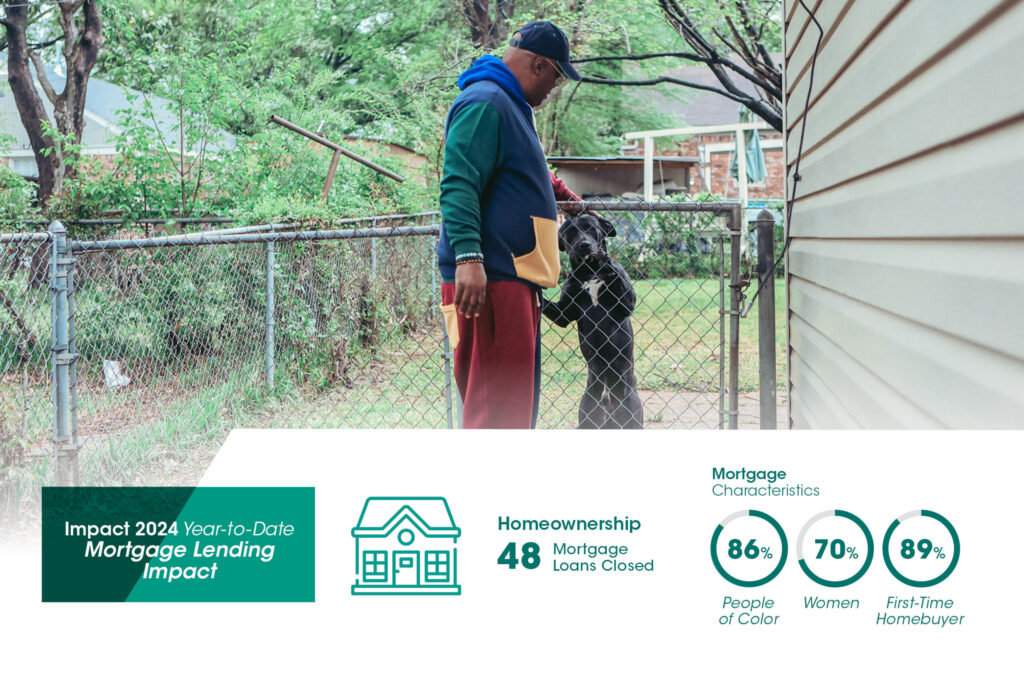
Five years ago, Donnell Frost couldn’t have imagined the transformative impact Hope Credit Union would have in helping him secure his first truck and home.
“HOPE gave me the hope to be the man I need to be,” Frost reflects as he plays with his dog in the spacious backyard of his new home in East Memphis. His path to HOPE began when he found himself seeking stable housing after leaving a transitional home. Although a nine-month home readiness journey was challenging, Frost was determined and patient throughout. According to Frost, “Being patient was the toughest part of the process,” but HOPE continued to provide him with much-needed guidance and support. In the end, HOPE was able to cover the closing costs for his mortgage, making homeownership more accessible.
Looking back at his long and determined journey, Frost is grateful that HOPE trusted him and allowed him to be a part of the family. Thanks to Hope Credit Union, he now has the opportunity to grow and have the things that he wants in life.

Financing Made Seamless
After 40 years owning Dixon Interior Finishing, a general contracting firm in Jackson, Mississippi, Frank Dixon figured it was never too late to learn something new. So, he and his sons, who are gradually assuming control of the company, enrolled in a HOPE pilot program intended to break down barriers for Black-owned businesses.
Dixon now says that HOPE will be his company’s “go-to” financial institution. And as the founder of Jackson’s Minority Contractors Association, he urges others to think the same. “After you’ve been turned down so many times from other banks, it discourages folks from seeking out loans. But I’m a living witness that HOPE will work with you,” Dixon said. “I have a pretty good relationship with them, and that’s what it’s all about, creating relationships.”
With funding from the Rockefeller Foundation, HOPE designed the Supplier Diversity Pilot Project to help diverse business owners and large entities such as municipalities, utilities, hospitals, etc., better understand and navigate their respective contracting and procurement needs, and to facilitate the financing, technical assistance and relationships required to grow and strengthen diverse businesses.
For nine months, HOPE’s expert staff worked with Dixon along with other small business owners to prepare them to compete for larger contracts and apply for capital by shoring up fundamentals such as financial statements and licensing. Owners that completed the program became eligible for forgivable, zero-interest loans as well as other services from HOPE. Dixon’s company also received $10,000 in affordable financing. “A lot of minority businesses have the skills to do the work, but we don’t have the organizational skills we need,” Dixon said, such as keeping financial records and filings updated. “That’s where they were really helpful.”

Firing on All Cylinders
With extensive knowledge of vehicles, Cindy DeLongchamp and her husband started Montgomery Automotive Group (MAG) in Montgomery, Alabama, in 1998. MAG sells high-quality pre-owned vehicles from top brands. MAG’s primary purpose is to provide military personnel with reliable vehicles, whether they are in Alabama or abroad. Located near Maxwell Air Force Base, MAG also offers a program that provides rental vehicles for military officers coming to Alabama for training. “We aren’t going to give them just any vehicle; it will be something we’d want to drive,” said DeLongchamp. She learned about Hope Credit Union through a long financial relationship with a HOPE associate. “When I go to a bank, I like to know who’s working there. I like for them to know me,” said DeLongchamp. She wanted to establish a line of credit with HOPE to purchase equipment and for working capital. DeLongchamp closed her line of credit with her bank and opened a $150,000 line at HOPE. “I like the idea of having a safety net in case I may need funding for capital later,” said DeLongchamp. “Hope Credit Union is my safety net.”
Cruising for La Antojería (the Craving)
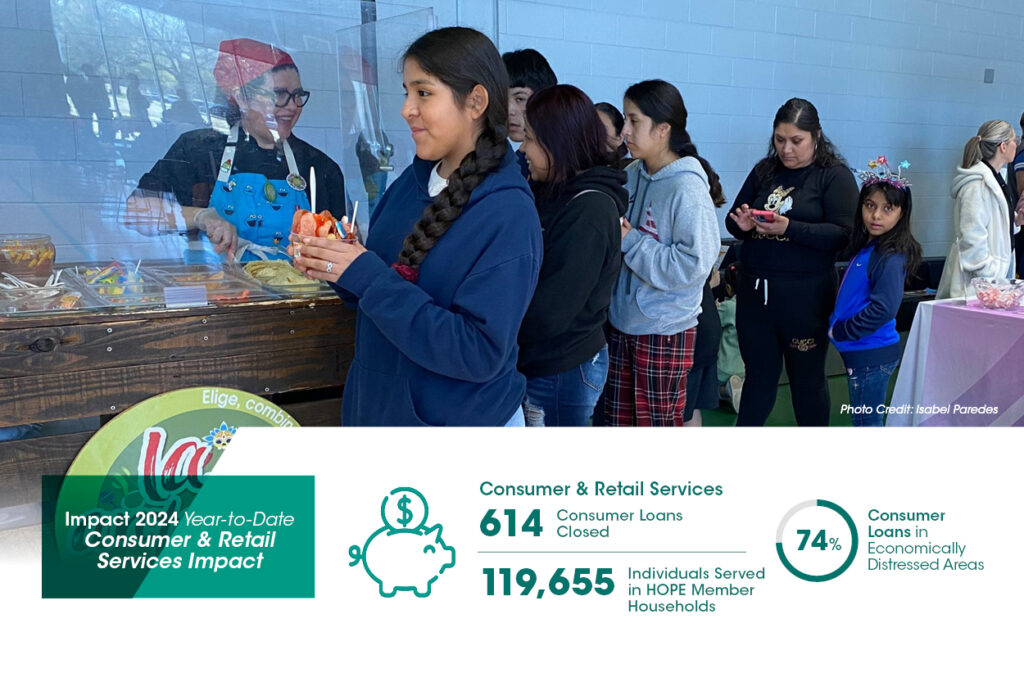
With a tasty combination of fruits, peanuts, and sweets dressed with savory sauce, La Antojería USA snack cart offers a wide variety of Mexican snacks that will satisfy any craving. When owner Nancy Hernández-Águila was ready to purchase a vehicle that would help with the demands of her thriving business, Hernández-Águila applied for an auto loan at two reputable financial institutions. “Even though my credit history is good, both of my applications were rejected,” says Hernández-Águila. At an event organized by the City of Memphis Business Office, she connected with an associate from Hope Credit Union. “At that moment, I knew that HOPE would open doors for me that were previously closed by my banks,” says Hernández-Águila. The knowledgeable staff at HOPE walked her through the loan process and provided guidance along the way. “It was very simple. I received guidance from a financial advisor in Spanish. He kept me abreast of the process until the vehicle was purchased,” says Hernández-Águila. She received $24,000 in financing for her vehicle. “I feel so grateful! This van will allow me to serve more customers daily, expand my services, and eventually generate jobs. It’s been a blessing and a life-changing opportunity!”

Reaching for the Stars
HOPE celebrated the groundbreaking for the renovation of the Russell C. Davis Planetarium, marking a pivotal moment in downtown Jackson’s renaissance. The project, supported by Hope Enterprise Corporation and other financing partners, aims to revitalize the outdated facility and transform it into a hub of world-class science enrichment, cultural experiences, and economic development opportunities for the region. With a $13 million investment through the New Markets Tax Credit (NMTC) program, the renovated facility will offer state-of-the-art programming inspiring students to learn more about the universe and pursue their goals. “It is all about opening young peoples’ minds to many possibilities,” says the project’s supporters.
The planetarium investment turns the tide on a wave of outmigration from downtown. Set to open in the summer of 2025, it symbolizes a bold step towards a vibrant future, embodying the emerging vision for downtown Jackson as a center for arts, education, and innovation.

Fostering Creative Excellence
In Fort Smith, Arkansas, a place for creativity is rising, casting its light on an entire community. The Community School for the Arts, nestled by the riverfront, looks forward to transformative changes thanks to $5 million in funding through the federal New Markets Tax Credit program. The NMTC program is designed to attract private-sector capital investments into the nation’s urban and rural low-income areas in an effort to help expand access to quality jobs, healthcare, education, and other critical services in those communities.
This landmark investment is a significant milestone for the city of Fort Smith, which is benefitting from its first NMTC investment.
HOPE joined three other community development financial institutions and banks to finance the completion of the 42,000-square-foot facility set to open this August.
The Center for Creative Arts will serve as a beacon of artistic excellence, offering inclusive arts education for young children through high school. CSA, established in 2016, offers after-school, evening, and weekend programs for youth of all ages and skill levels taught by professional artists. The high school, called the Institute for the Creative Arts, is the first of its kind in Arkansas and will be housed in CSA’s Center for the Creative Arts.
As a public charter school, the Institute is tuition-free and open to all students. The Institute will combine a rigorous college preparatory academic program with pre-professional training in the arts, which will include music, theatre, dance, visual art, film, and culinary.
Seizing the Moment: Maximizing Federal Investments in Under Resourced Communities
Federal officials and local leaders gathered in Cleveland, Mississippi, for the HOPE Economic Mobility Forum: Seizing the Moment to help ensure that Deep South communities benefit from the historic level of resources that are available through the American Rescue Plan, Bipartisan Infrastructure Law, and Inflation Reduction Act. The day started with opening remarks from the USDA Undersecretary for Rural Development and an overview of the economic mobility conditions facing the region. Next, local leaders from the Mississippi Delta shared their experiences in successfully accessing federal resources to make infrastructure improvements in their small towns and rural counties. Federal officials from the US Treasury and White House Council on Environmental Quality also provided an introduction to Direct pay, a tool local governments and nonprofit organizations can use to take advantage of tax credits designed for clean energy investments. Following lunch, attendees participated in a Community Leadership Institute where subject matter experts and assistance providers from nearly a dozen federal agencies and nonprofit organizations provided information about relevant programs and support.
Making HBCU History
In February, the Gulf Coast Athletic Conference (GCAC) announced it will officially become the HBCU Athletic Conference, emphasizing the significance of Historically Black Colleges and Universities. During the announcement, the conference’s commissioner, Dr. Kiki Baker Barnes, highlighted the partnership with Hope Credit Union, GCAC’s official financial institution and lead sponsor for the Men’s and Women’s Basketball and Baseball tournaments since 2022. “Today, the nation watches as we give our HBCU students the opportunity to take up space. Whether it’s on the field, in classrooms, or at their local bank, we want to ensure that HBCU students feel seen and represented,” says Commissioner Barnes.
The partnership extends through 2027 and aims to increase economic mobility among staff, students, alumni, and surrounding communities of GCAC institutions.
Download 2024 1st Quarter Report.